

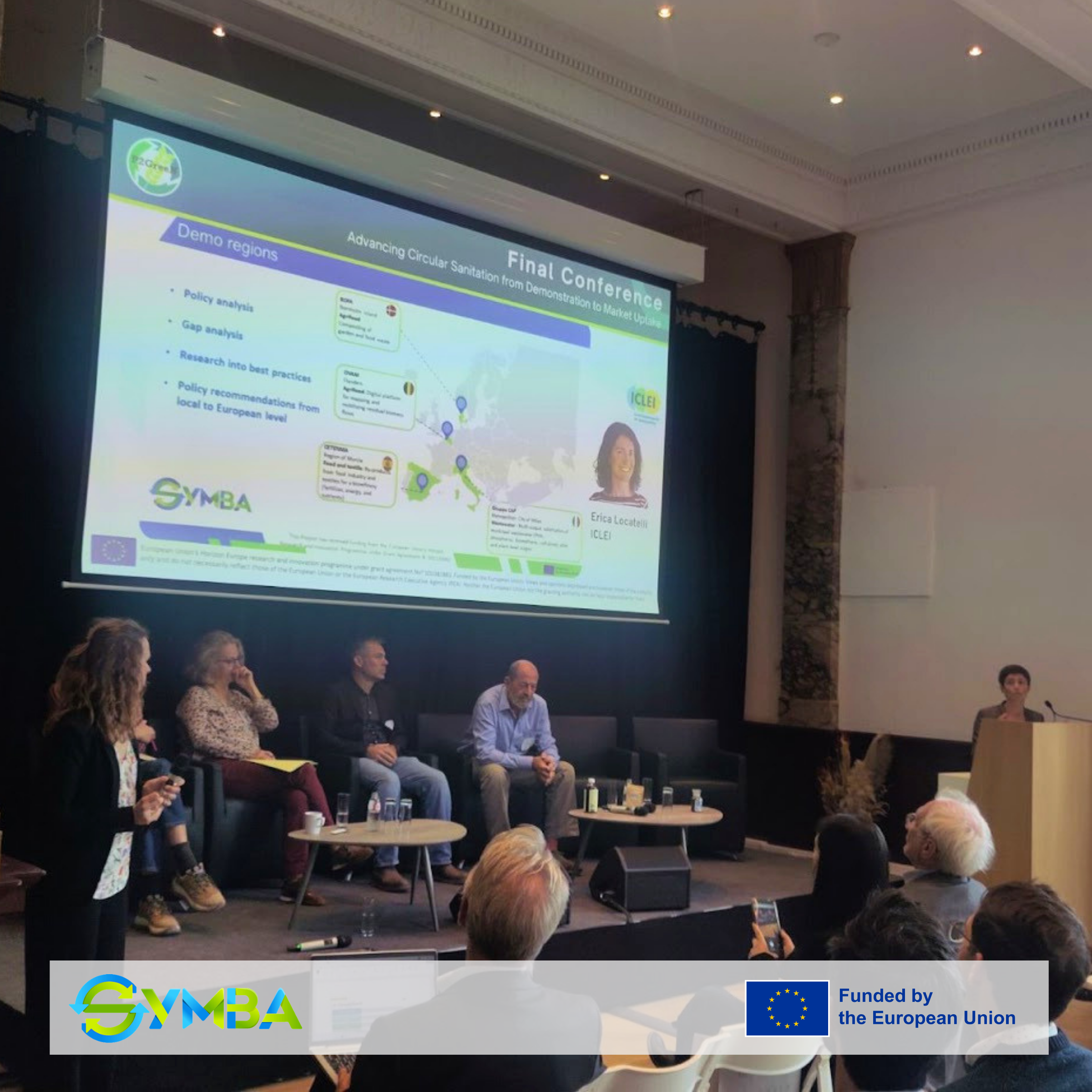
As SYMBA is at its final months, the project continues to exchange knowledge with European initiatives working towards a more circular and resource-efficient economy. On 7 October 2026, SYMBA participated in the P2GreeN Final Conference in Brussels, Belgium, joining policymakers, researchers and industry stakeholders to discuss the challenges and opportunities of scaling up circular solutions and innovative bio-based technologies.
The conference, entitled “Advancing Circular Sanitation from Demonstration to Market Uptake”, brought together more than 70 participants, including policymakers, researchers, wastewater operators and agri-food professionals, to exchange knowledge, share practical experiences and explore pathways towards a more circular and resource-efficient economy.
Organised within the framework of the P2GreeN project, the event featured three expert panels addressing the practical implementation of pilot technologies, legislative and governance challenges, and the conditions needed to support the replication and market uptake of innovative circular solutions.
SYMBA was represented by Erica Locatelli and Marianne Wagner from ICLEI Europe, who contributed to the event through project dissemination activities and networking opportunities. During the third panel, “Potential for Replication and Conditions of Success”, Erica Locatelli delivered a presentation introducing SYMBA , highlighting its objectives, key activities and demonstration regions. With SYMBA now approaching the final stages of its implementation, the conference offered a timely opportunity to share the project’s approach to industrial symbiosis and reflect on how innovative waste valorisation solutions can move towards broader application. The exchange with P2GreeN and other stakeholders highlighted the importance of building on the knowledge and experiences developed through European research and innovation projects to support the long-term transition towards a circular bioeconomy.
As P2GreeN celebrated its final conference and SYMBA moved closer to the completion of its activities, a common question emerged: how can innovative circular solutions continue to deliver impact beyond the lifetime of individual projects? This challenge was central to the discussions during the third panel, which explored the key enabling factors and barriers to scaling up bio-based technologies for waste valorisation. Particular attention was given to the regulatory and economic conditions required to support market uptake, including the need for appropriate policy frameworks that encourage innovation while ensuring the competitiveness of novel bio-based products. These exchanges are especially relevant for SYMBA as it is at its final stage, when knowledge sharing, the exploitation of project outcomes and the potential for replication become increasingly important for ensuring lasting impact.
Beyond the panel discussions, the conference provided a valuable opportunity for SYMBA to engage with stakeholders working on complementary circular economy initiatives, exchange knowledge and explore potential synergies.
A special thank you to the P2GreeN project for bringing together such a diverse community of experts and stakeholders and creating a valuable space for dialogue on the future of circular innovation in Europe. As P2GreeN concludes its journey and SYMBA approaches its own final milestones, events like this remind us that the end of a project does not mean the end of its impact. By sharing knowledge, strengthening collaboration and supporting the replication of innovative solutions, European projects can continue contributing to a more sustainable and circular future.